


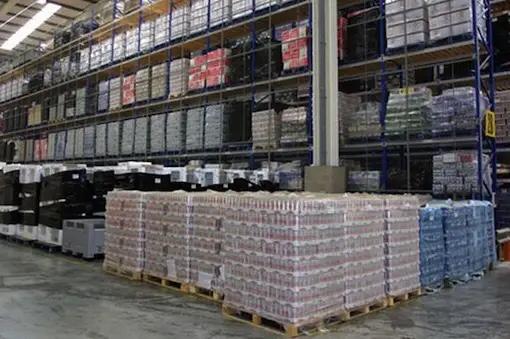
AGAINST the backdrop of sustained pressure in the foreign exchange market and high cost of production, the Manufacturers Association of Nigeria, MAN has indicated that inventory of unsold goods is escalating to levels now threatening the existence of companies operating in the production sector of the economy with attendant job losses.
Financial Vanguard’s findings show that as of the weekend the foreign exchange market had recorded over 254 per cent plunge in the value of the naira since flotation of the currency by the Central Bank of Nigeria (CBN) in June 2023.
Recall that the naira traded for N471 per dollar in the official I&E market on June 13, 2023 before the floatation of the currency, but exchanged for N1,665.50 to a dollar as at February 23, 2024 on the Nigerian Foreign Exchange Market (NAFEM), indicating a depreciation of more than 253.6 per cent over the eight-month period. The forex crisis is also stoking inflation, and coupled with high energy costs, purchasing power has continued plummet, stifling demand for goods.
Speaking on the impact of this development on the manufacturing sector, Director General, MAN, Segun Ajayi-Kadir, said: “There are reports that across the board, many warehouses and plants of many manufacturing firms are stockpiled with unsold goods manufactured last year. “The development is as a result of the devastating effects of the exchange rate crisis, inflation, fake and sub-standard goods, smuggling and other macro-economics challenges.
“These had put many manufacturers in a great dilemma in the current year as they are applying brakes on production by watching keenly events in the country to know if there would be improvement in sales in order to create space for fresh production for the year.” Ajayi-Kadir warned that manufacturers may be forced to halt making new products, leading to workforce down-sizing, since production lines are becoming inactive. “The continued naira depreciation against the dollar, and the general forex volatility were forcing manufacturers to have a rethink. No genuine manufacturer could operate successfully and make profit under the current scenario, whereby the naira has been falling sharply more than expected in the country,” he stated.
Highlighting challenges in accessing foreign exchange (forex), Ajayi-Kadir disclosed that manufacturers primarily obtain forex through Bureaux De Change (BDCs), noting that banks typically offer less than 20 per cent of the required amount. No respite yet There seems to be no respite in sight as the International Monetary Fund (IMF) has warned that the exchange rate of the Naira may further depreciate by about 35 per cent this year, adding that this could lead to inflation rate peaking at 44 per cent.
“Given the absence of local production and the recent liberalization of commodity imports, the exchange rate would likely depreciate further – by an estimated 35 per cent in 2024 – and contribute to a further sharp rise in inflation, peaking at 44 per cent, before monetary policy is eventually tightened sharply,” IMF stated in its February 2024 Post-Financing Assessment and Staff Report.
Financial Vanguard reports that manufacturing companies have been adopting diverse responses to the situation. A good number of them have been investing in backward integration for sourcing raw materials locally instead of imports that strangulate their finances due to the high exchange rate and scarcity of foreign currency. But some of the manufacturers are scaling down their operations while many have actually suspended operations.
Companies’ woes Against the backdrop of the forex crisis, Nigerian Breweries (NB) Plc recently issued a new price review notification to all its customers in the West Zone. In the notice to its consumers, NB said: “This is to inform you that we are constrained to review the prices of some of our stock keeping units (SKUs) with effect from Monday 19th February, 2024. This review has become necessary because of continued rising input costs and the need to mitigate the impact.”
SKU is a unique identifier used to track inventory within a business. Nigerian Breweries produces major alcoholic beverages like Star Lager, Gulder, Legend Extra Stout, Heineken, Goldberg, Life, and Star Radler amongst others. It also produces non-alcoholic drinks like Maltina, Amstel Malta, Fayrouz, Climax Energy drink, and Malta Gold. In a related development, in December 2023, Procter & Gamble (P&G) said it was leaving Nigeria, after just opening its diaper production line worth $300 million in Lagos in 2017. Other global conglomerates that have announced their exit from the country in the recent past include GSK Plc, Bayer AG and Sanofi SA.
Also last year, Unilever Plc cut some of the products manufactured in Nigeria, while Nestle SA has posted losses from its operations. The main reason for the exodus of these conglomerates is scarcity of dollars that they need to repatriate their earnings, with CBN still struggling to clear a backlog of demand for dollars companies require to pay debts and import raw materials.
This is in addition to a near complete absence of reliable electricity supply and congestion at the nation’s ports.
On short-term measures to alleviate challenges faced by manufacturers, Ajayi-Kadir recommended freezing the rates at which the import of raw materials, spares, and machines is calculated. According to him, this would provide stability for manufacturers, shielding them from the impact of fluctuating currency values and fostering a more predictable business environment.
He also proposed that the government open new credit sources with rates not exceeding 5 per cent, providing quick wins to alleviate pressure on the manufacturing sector. “Additionally, the government should remove the price verification porter because it’s causing companies to shut down, they are not able to import those raw materials.
“The government should also open new windows for us to source our credit at rates that are not lower and that are not higher than 5 percent. “These are very quick wins that the government can do that can lower the pressure that is upon the manufacturing sector,” he said.
The MAN DG also emphasized the importance of promoting domestic production. “Historically, we have not prioritized our domestic economy or encouraged local production. Without local production, we cannot control the exchange rate or achieve a positive rate. Our reliance on imports leads to continuous pressure on the Naira to pursue the Dollar, resulting in an unfavorable exchange rate,” he stated.
MSMEs further threatened
On his part, Dr Femi Egbesola, President, Association of Small Business Owners of Nigeria (ASBON), blames the forex crisis on unrealistic and inconsistent fiscal and monetary policies. “So many policies of the government this past time have done more damage than good to the forex market. To get a different result, something must just be done differently,” he said. On what the forex crisis portends for small businesses, Eg-besola stated: “Existence of more micro and small businesses are further threatened. Many more businesses are closing down or are in an ailing situation.
“This results to more job losses, loss of revenue to government because dead businesses can’t pay taxes and levies, discourages foreign investment and local investors, increases crime and insecurity, for jobless ones will look for other means of survival, mostly illegal means, owners of businesses are now abandoning their unproductive and unprofitable businesses to relocate overseas, higher inflation rate and more.” He advised that small businesses need to be more creative and innovative now more than ever before. “Business owners need to begin to diversify to foods and daily need products. More attention should be on exportable products that can earn forex.
“SMEs should adopt the use of technology now more than ever before. Technology adoption will significantly reduce business cost. SMEs need to invest in online marketing and advertising of their products and services. This breaks borders and opens bigger markets. “SMEs should begin to take advantage of the African Free Continental Free Trade Area (AfCFTA) opportunities to sell their products and services to other African countries without the statutory levies and taxes. This will lead to increase in sales and eventually push up productivity and profitability,” he added.
Managed naira float
In his comment, Dr Muda Yusuf, CEO, Centre for the Promotion of Private Enterprise (CPPE), said: “The depreciation of the naira exchange rate is an inevitable outcome of the current economic reforms. The primary objective is to correct the distortions in the foreign exchange market which had lingered for some time. Admittedly, the economic, social and political costs are quite high. “The main anchor of the reform is the unification of the exchange rate, between the official and parallel markets. The challenge has been that our foreign reserves are not robust enough to make the process less painful.
The economy is still grappling with a major forex liquidity crisis.” Yusuf added that the implications of the current crisis for investors and citizens are multifaceted. “They include: intense inflationary pressures; escalating production and operating costs across all sectors of the economy; erosion of profit margins as businesses could not significantly transfer increased costs to consumers. “Businesses that have foreign exchange exposure are under severe pressure; businesses with foreign shareholders are struggling to deliver value to their offshore shareholders because of the erosion of domestic currency value; and planning has become difficult for many investors because of the current volatilities.”
He said that the current policy reforms are expected to ensure stability in the short to medium term, adding however that the reform architecture needs to be periodically reviewed in the light of the high social costs and market imperfections. “The trade policy window should be explored to mitigate the current escalating prices and production costs. The recent upward review of the exchange rate benchmark for the import duty computation should be reviewed. Trade costs should generally be moderated to give succour to businesses and citizens. “Complete and total floatation of the currency should be avoided in the light of glaring market imperfections. CBN should commit to the option of a managed float. The policy choice of complete floating of the naira requires a rethink in the light of the current inflationary outcomes, volatility and mark
