

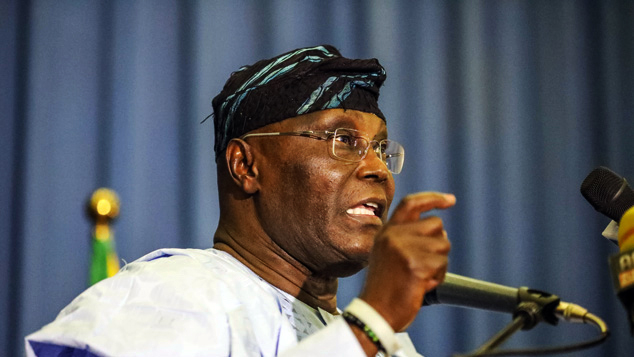
Former Vice President Atiku Abubakar has accused President Bola Ahmed Tinubu’s administration of hypocrisy over its handling of petroleum-sector interventions, arguing that the government cannot claim to have abolished subsidy while simultaneously granting tax credits, concessions and other fiscal incentives to major operators in the oil and gas industry.
Atiku, in a statement on Sunday in Abuja by his Senior Special Assistant on Public Communication, Phrank Shaibu, said the administration’s celebration of subsidy removal was misleading because Nigerians had continued to bear the cost of government interventions in the petroleum sector through various forms of under-recovery and energy-security expenditure.
He said the controversy had become more pronounced following the unveiling of his Atiku Economic Recovery Plan (AERP), which proposes a targeted, capped and transparently administered intervention to cushion the effect of high energy costs on Nigerian households while accelerating domestic refining and reducing dependence on imported petroleum products.
According to Atiku, Tinubu’s administration appears to oppose government intervention only when the intended beneficiaries are ordinary Nigerians.
“Tinubu stood at Eagle Square and declared that subsidy was gone. Petrol prices exploded, transportation costs soared, food prices followed, businesses buckled and household purchasing power collapsed. Nigerians were told there was no alternative and that enduring this pain was the necessary price of economic reform.
“But when major oil investors knock on Tinubu’s door, the sermon changes. Suddenly, government intervention is good economics; tax credits are necessary; fiscal concessions are strategic; and private investment must be de-risked.
“Apparently, intervention is only unacceptable when poor Nigerians are the beneficiaries,” the statement said.
Atiku cited the government’s incentives for deep offshore oil and gas projects as an example of what he described as selective economic intervention.
He noted that qualifying petroleum developments can benefit from production tax credits and supplementary incentives under the government’s fiscal framework, arguing that such measures demonstrate that intervention is not inherently incompatible with market economics.
“So, what exactly is Tinubu’s objection: government intervention itself, or government intervention for Nigerians?” he asked.
The former Vice President also questioned the government’s description of petroleum-sector expenditure following the removal of petrol subsidy, pointing to figures contained in NNPC’s audited accounts.
He said NNPC’s 2023 accounts recorded approximately ₦4.84 trillion in energy-security expenses and related shortfalls, while its 2024 audited financial statements recorded approximately ₦7.13 trillion under energy-security expenses.
Atiku said NNPC had explained that part of the expenditure arose from the difference between the exchange rate used in determining the regulated PMS ex-coastal price and the prevailing exchange rate when import obligations were settled.
“In plain English, government was still absorbing a price differential after Tinubu had triumphantly announced that subsidy was gone,” he said.
He challenged the administration to explain the distinction between subsidy, under-recovery, shortfall and energy-security expenditure where public funds were used to bridge a gap between the economic cost of petroleum products and the price at which they were sold.
Atiku said: “Nigerians do not eat semantics. Whether government calls it subsidy, under-recovery, shortfall or energy security, public resources were being used to bridge a gap between economic cost and the price at which petrol was sold.
“You cannot abolish subsidy at the podium and resurrect it in the accounts under an alias.”
Atiku argued that the central issue was not whether government should intervene in the economy, but whether such intervention should be designed primarily to protect corporate investment or to shield ordinary Nigerians from severe economic hardship.
He said the Tinubu administration could not, on the one hand, provide fiscal incentives designed to reduce investment risks in the petroleum sector and, on the other, dismiss targeted measures aimed at reducing the burden of high energy costs on households as economically irresponsible.
“Tinubu cannot operate two economies in one country — savage capitalism for poor Nigerian families and compassionate capitalism for big oil operators.
“It is one rule for them and another rule for the rest of us,” he said.
According to him, the government’s economic policies have placed an excessive burden on workers, traders, farmers and families while offering various incentives to investors.
“The government can protect a multibillion-dollar oil investment from risk, yet it says protecting the Nigerian worker from crushing hardship is bad economics.
“It can provide fiscal cushions for petroleum investors while telling workers, traders, farmers and families to absorb every shock in the name of reform.
“That is not reform; it is an upside-down economy,” the former Vice President said.
Atiku stressed that his proposed intervention under the AERP should not be confused with the former subsidy regime, which he described as opaque and vulnerable to abuse.
He said his proposal was for a targeted, capped, transparently budgeted and independently audited intervention, with a clearly defined exit mechanism and measures to expand domestic refining, increase competition, improve mass transportation and restore household purchasing power.
“If government can legitimately de-risk investment, why is it economic heresy to de-risk survival?” he asked.
The former Vice President also called on the Federal Government to disclose the beneficiaries and financial implications of major petroleum-sector tax credits, concessions, remissions and other incentives.
“Nigerians deserve to know the beneficiaries of major petroleum tax credits, remissions and incentives, the value of revenue surrendered, the investments delivered in return and whether Nigerian investors have equal and transparent access to comparable incentives.
“These concessions belong to the Nigerian people and must never become instruments of patronage dispensed behind closed doors,” he said.
Atiku said he supports domestic and foreign investment and recognises the role of transparent, performance-based incentives in attracting capital.
Atiku said: “What we reject is the intellectual dishonesty of pretending that government intervention becomes sound economics when corporations benefit and economic ignorance when Nigerian citizens benefit.
“You cannot subsidise capital and criminalise relief for citizens. You cannot offer cushions upstairs and call suffering downstairs reform.”
He said the ultimate test of economic reform should not be how loudly a government announces the removal of subsidy, but whether Nigerians are better off, businesses are productive, jobs are being created and household incomes can meet basic living costs.
“The Atiku Economic Recovery Plan is founded on a fundamentally different philosophy: markets must work, investment must earn a fair return and public finances must be protected, but the Nigerian citizen must remain the ultimate beneficiary of economic policy.
“A government cannot preach unrestrained market forces to the poor while practising interventionist economics for powerful corporate interests. It cannot demand sacrifice from Nigerian families while extending concessions to investors and then call the resulting hardship reform.
“That is not economic reform. It is economic apartheid,” Atiku said.
