

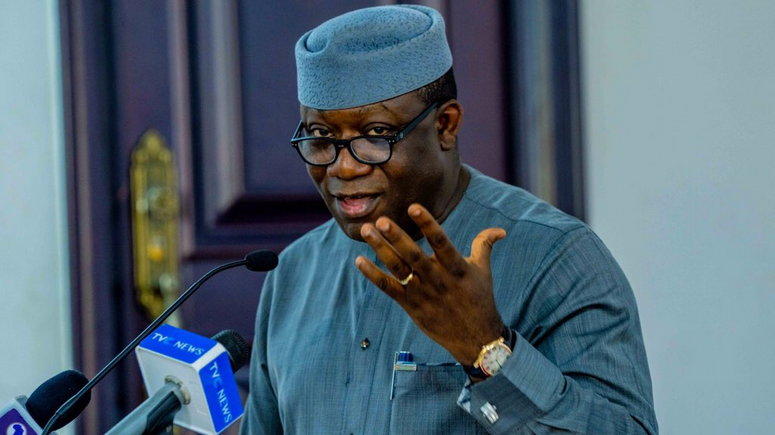
Former Ekiti State Governor and ex-Minister of Solid Minerals Development, Kayode Fayemi, has likened African Democratic Congress presidential candidate Atiku Abubakar’s promise to restore fuel subsidy to the All Progressives Congress’ controversial Muslim-Muslim presidential ticket in the last general election.
Fayemi described Atiku’s subsidy proposal as a political strategy designed to appeal to Nigerians struggling with the economic consequences of petrol subsidy removal rather than a sustainable economic policy.
Speaking on Arise Television’s Prime Time on Monday, Fayemi said, “My take on that is that Atiku’s proposal of subsidy is politically equivalent to our own Muslim-Muslim ticket in 2023. It’s a political strategy. It’s not an economic construct.”
He, however, acknowledged that the proposal could gain traction among Nigerians who have borne the brunt of higher fuel prices, transportation costs and the broader cost-of-living crisis triggered by subsidy removal.
According to him, vulnerable Nigerians were primarily concerned about their ability to survive economically rather than the technical arguments surrounding subsidy policy.
“But understandably, it’s a political strategy that will sell with those who are hard done by the impact of fuel subsidy removal,” he said.
Fayemi maintained his longstanding support for the removal of petrol subsidy, recalling that he had advocated the policy while serving as chairman of the Nigerian Governors’ Forum.
“I was and I remain an advocate of fuel subsidy removal. As chairman of the governors’ forum, I spent four years in this battle,” he said.
The former governor, however, faulted the manner in which President Bola Tinubu implemented the policy, arguing that the groundwork for subsidy removal had largely been completed by the previous administration.
“What President Tinubu inherited, in fairness to him, was the work that had already been completed by that administration. The only challenge I had with it was the way it was done,” Fayemi said.
He further disclosed that state governors had worked with the Federal Government and the World Bank to develop a safety-net programme intended to protect vulnerable Nigerians from the impact of subsidy removal.
Fayemi said the failure to adequately cushion the effects of the policy had created an opportunity for Atiku to exploit public dissatisfaction politically.
“I believe that’s what Vice President Atiku is taking advantage of. The vulnerable segment of the population is still hard done by,” he said.
He noted that millions of Nigerians were more concerned about putting food on their tables, paying school fees and meeting healthcare expenses than engaging in technical debates over the economics of fuel subsidy.
“They just want to live reasonably well, eke out a living, have one or two meals a day, be able to send their kids to school, not be taken in by sickness or anything that might create further problems for them,” Fayemi said.
He also linked widespread poverty and inequality to insecurity, saying they were among the underlying factors fuelling insurgency and banditry across the country.
Fayemi’s comments came after Atiku reiterated his pledge to restore fuel subsidy if elected president in 2027, although the ADC candidate has framed his proposal as a “Production Subsidy” aimed at supporting domestic refining and production rather than simply subsidising consumption.
Atiku has argued that the policy would increase fuel supply, support local production and ultimately reduce pump prices for Nigerians.
In a statement issued on Sunday by his Special Adviser on Media and Publicity, Phrank Shaibu, Atiku also claimed that United States President Donald Trump supports his position on fuel subsidy.
The former Vice President cited the Crude Oil Refiners Association of Nigeria’s advocacy for stronger support for domestic refining, arguing that strategic intervention in the energy sector could benefit both producers and consumers.
“This is why my Production Subsidy is about putting money back into people’s pockets. Support what we produce and refine here, increase supply, monitor the price and make sure Nigerians feel the benefit at the pump,” Atiku said.
He also accused the Tinubu administration of opposing relief measures for ordinary Nigerians while granting waivers, incentives and concessions to multinational oil companies and businesses allegedly linked to the government.
“So why does intervention suddenly become bad economics when ordinary Nigerians are meant to benefit?” Atiku asked.
