

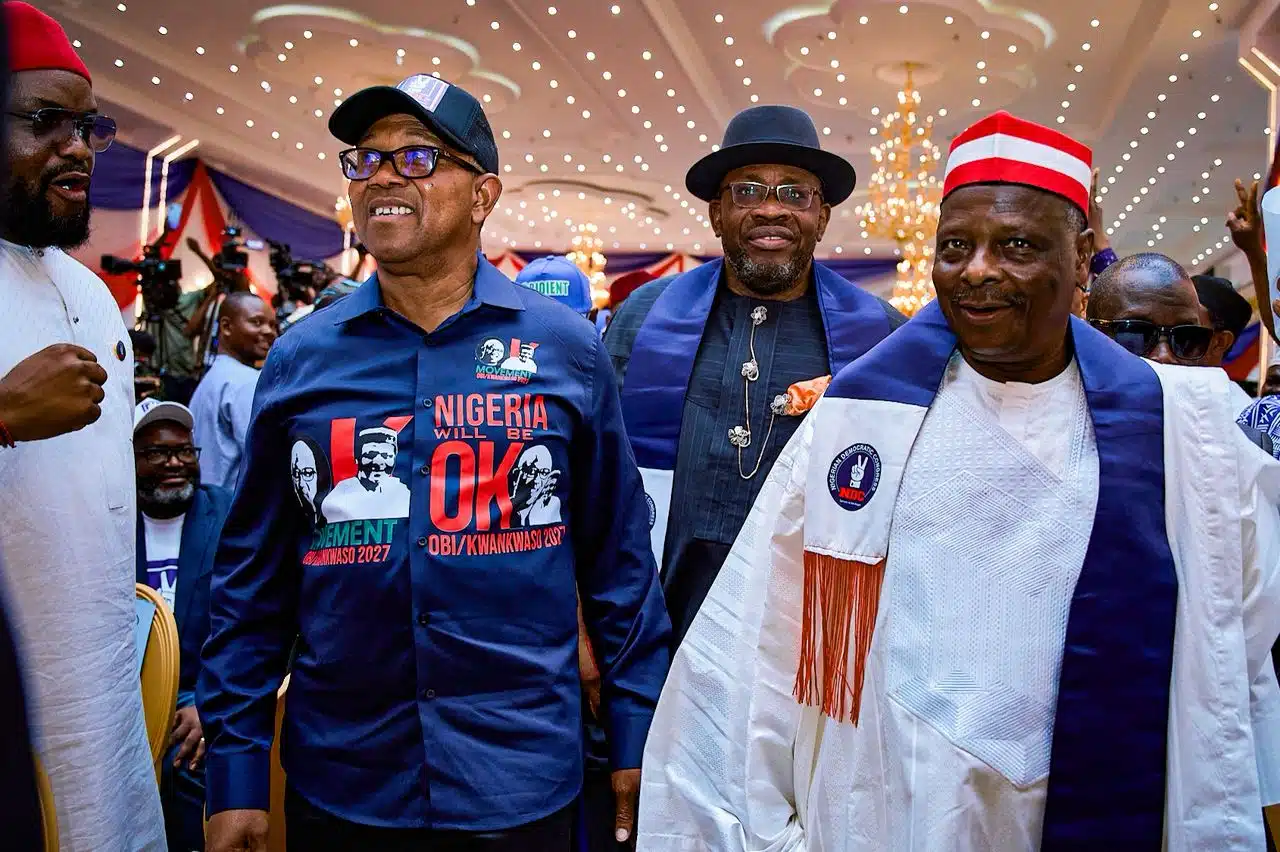
The Nigeria Democratic Congress (NDC) is facing a fresh internal disagreement over the role and control of support groups backing its 2027 presidential ticket of Peter Obi and Rabiu Kwankwaso.
This latest dispute centres on the relationship between the party and organisations such as the Obi-Kwankwaso Movement, Obidient groups and Kwankwasiyya.
Some of the groups insists that their existing structures cannot be placed under the direct control of the NDC.
The disagreement has become more pronounced after the NDC moved to establish clearer structures for support groups ahead of the 2027 general elections.
While the party maintains that support organisations must complement its official structures, the Obi-Kwankwaso Movement has insisted that political cooperation does not mean surrendering its identity, leadership or grassroots structures to the party.
The dispute is coming days after the NDC rejected a 59-member Presidential Campaign Council announced by the Obi-Kwankwaso Movement.
The movement had unveiled the council on September 17 as part of its mobilisation plans for the 2027 election.
However, the NDC later said the structure was not authorised by its leadership.
The party’s National Chairman, Senator Cleopas Moses, said the public should disregard the campaign council because it did not originate from the party or receive approval from its National Working Committee.
The National Leader of the NDC, Senator Seriake Dickson, had argued that support groups should focus on mobilisation and support for candidates instead of creating structures that could compete with the party.
“Support groups don’t compete with the political party that is sponsoring candidates. Support groups don’t compete for supremacy, for space. Support groups are what they are, support groups,” Dickson said.
He also questioned the decision of the OK Movement to establish a presidential campaign council, describing the move as outside the traditional role of a support organisation.
Dickson maintained that the NDC was ready to accommodate different support groups but expected them to operate within their designated roles.
The OK Movement, however, has rejected the suggestion that it is simply an appendage of the NDC.
Its Director-General, John Ughulu, said the movement was independently established and had developed its own structures across the country.
